Sunday, February 24, 2008

A Little Knowledge Is a Dangerous Thing

I recently came across this article in Dissent, a magazine I've lately been reading online chiefly because its editors just republished this article to commemorate Richard Rorty's death. The Gewen article is a response to Alex Ross's new book The Rest Is Noise, and while I'm sympathetic to much of what it says, it also illustrates one of the reasons I bother with this blog (and why I went through the trouble of all those music primer posts last summer).

Gewen's thesis is, basically, that rock music is where the tonal tradition that stretches from Bach through Mahler went to hide in the second half of the 20th century, and I think he's largely right. I also think he's entirely wrong to portray himself as somehow rebutting Alex's thesis in The Rest Is Noise. Gewen claims that
Ross demands the Gershwin of the concert hall. He stresses the man’s sophisticated musical training and twice tells us the story of an encounter with Alban Berg. Gershwin, Ross reports, was “awestruck” by Berg’s compositions, which may have given him “a glimpse of something new, a deeper synthesis than what he had achieved to date”—which is to say, only “Rhapsody in Blue,” the “Concerto in F,” and a slew of songs like “Fascinatin’ Rhythm,” “The Man I Love” and “Someone to Watch Over Me.” (Poor, poor pitiful George.)
But Gershwin could not have written his best songs without his sophisticated musical training, any more than Burt Bacharach could have written his, and when Alex mentions Gershwin's glimpse of "a deeper synthesis", he's talking about Porgy and Bess. You don't have to be a musical snob to believe that Porgy is more ambitious than "Someone to Watch over Me". Indeed, Alex's verdict on Porgy is that it's precisely because it was a new synthesis that it didn't get the reception it deserved: neither the classical snobs nor the jazz musicians could cotton to it. Anyone who's read Alex on the topic of Duke Ellington's "Come Sunday", or on Bjork, Radiohead, or Dylan in the New Yorker, knows that he's not trying to shoehorn pop music into the classical tradition.

Gewen also heaps scorn on Alex's claim that in 20th-century music, "the rain of beauty never ended." "Who knew?" Gewen replies.
Young audiences, he writes, now “crowd into small halls,” presumably to be drenched by beauty’s downpour. Well, hope springs eternal. But it has been almost a hundred years since Arnold Schoenberg devised his twelve-tone system to free the West from the chains of tonality, and the West continues to embrace its chains. During the 1970s, Pierre Boulez, as head of the New York Philharmonic, made it his mission to instruct New York audiences in the beauties of modern music. Instead, he found that instruction was difficult when the pupils refused to attend class.
But the beauty Alex champions in his book is not only, or even chiefly, the beauty that some people find in the work of the most austere serialists. Alex devotes whole chapters to Sibelius, Copland, Shostakovich and Prokofiev, and Britten, composers singled out precisely because they composed in a tonal idiom in the midst of the serialist frenzy. If young people prefer Radiohead or Metallica to Shostakovich and Copland, it has nothing to do with tonality or atonality; the same young people also prefer Radiohead or Metallica to Brahms and Mahler. Indeed, the average Metallica fan might find a lot more to appreciate in the savage portrait of Stalin in Shostakovich's Tenth than in the closely argued development of solid Germanic themes in Brahms's symphonies.

Anyway ... I didn't actually begin this post intending to defend Alex from Gewen. I really just wanted to discuss a remark Gewen makes toward the end of his essay:
Songs written in the [pentatonic] scale above may be in the key of C or the key of G; without an F or an F#, there’s no way of knowing. Pentatonic melodies have a more skeletal quality, as with Dylan’s “Percy’s Song” or the Beatles’ “Norwegian Wood.”
This is totally wrong. The main melody of "Norwegian Wood" is, like a lot of music by the Beatles and other English rock bands of the sixties, in the mixolydian mode. Unlike the pentatonic scale, which, as its name would imply, uses only five notes, the mixolydian mode uses the same seven notes that the major scale does; it just starts on a different scale degree. The bridge of "Norwegian Wood" modulates into the parallel minor of the main melody's mode, adding yet an eighth note to the seven of the preceding section. (For an example of what pentatonic melody really sounds like, listen to the chorus of Michael Penn's "No Myth". The verse melody also starts out using the pentatonic scale, but it can't help throwing in the leading tone--the "ti" of the do-re-mi scale--at the end. In music in the Western tonal tradition--and I agree with Gewen that both the Beatles and Michael Penn fit into that tradition--it is hard to avoid the leading tone and the harmonic implications it carries.)

Gewen emphasizes the pentatonic scale because he thinks of it as a kind of pancultural lingua franca, and in a way, I suppose, it is. But all great musical artists--Brahms, Schoenberg, or John Lennon--try to find some way to expand the musical traditions they inherit. The pentatonic scale may, as Gewen suggests, create a bridge between Western and African musical cultures. But much African music also makes use of complex polyrhythms that only the best-trained Western musicians can keep up with. Slipping effortlessly between counting three and four beats per measure, often in the course of single measure, as West African drummers do, is not something you can learn to do in an afternoon--or even in a college semester, as I learned as an undergraduate. Rhythmically, West African music is every bit as complex as Bartok's music is harmonically.

The mixolydian scale is common in old English folk music; Ralph Vaughan Williams--another aggressively tonal 20th-century composer--uses it all the time in pieces that borrow from folk traditions. The flatted seventh degree, which is the signature modification of the mixolydian scale, is also common in blues music. I'm not sure which route John Lennon took to the mixolydian mode, but once he found it, he certainly made dramatic use of it. Beginning a piece in an unconventional mode and then modulating directly into a parallel mode is not some naive, intuitive gesture. It's exactly the kind of manipulation that 20th-century composers--like Gershwin and Stravinsky as well as Lennon--used to breathe new life into the tonal tradition.

Part of the motive behind my last few posts has been to try to show that the tools of musical analysis can tell us as much about the pop music we love as they can about classical music. Gewen actually seems to know more about music theory than most pop-music critics do. Which makes it all the more disappointing that he couldn't be bothered to actually look at the notes before opining about their cultural and historical significance.

Monday, December 3, 2007

Formalism vs. Contextualism, part two

In my last post, I was trying to clarify the point of contention between Arthur and me by distinguishing what I called formalism and contextualism and explaining how I thought Arthur had blurred the distinction. I'd also like to say a little bit about why I think I tend to fall on the formalist side of the divide.

The first point to make is that I don't always fall on the formalist side. There are some early songs of Bob Dylan's, for instance, that I would be hard pressed to defend on formal grounds but that frequently have a magical effect on me. That effect has to do with Dylan's possibly unprecedented way of singing, which owes something to Woody Guthrie--a loaded association for me already, since my dad was born into the same Oklahoma dust bowl that Guthrie wrote about--and which evokes something of Greil Marcus's "old, weird America," but which, because of Dylan's intimacy with the microphone, infuses the uncanniness of The Anthology of American Folk Music with a new human warmth. Where Dylan borrows lyrics from the folk tradition, that intimacy (which, by the way, disappeared very quickly, only to reemerge in the mid-1980s) recharges them with the romantic longing that must have animated them in the first place, and I associate that longing with the photo on the cover of Freewheelin', Dylan young and charmingly innocent with a girl on his arm, a photo that evokes the excitement of Greenwich Village in the early 1960s--which I also associate with my parents' youth, which coincided with Dylan's, and which I imagine now with the same fond nostalgia I feel when I remember my own, which like Dylan's was marked by musical ambition and coffee house performances and cheap apartments and long, late talks with people who seemed eccentric and brilliant and passionate. But at the same time, I can't look at that picture or listen to those recordings without imagining the haggard Dylan of today, who sings with such rue on Time Out of Mind, "I been to Sugar Town, I shook the sugar down," or without remembering the weird incense smell of the candlelit basement room in my freshman dorm where I listened to Dylan in earnest for the first time, sitting on the floor, and where the discovery of his music seemed like a ritual, a right of passage--all of which add to the swirl of sensations and emotions that the music elicits.

I could probably go on, but the basic point is that this is one case among many where what matters most to me about a group of recordings seems to be "what they mean culturally", in Arthur's formula. I treasure the experience of listening to those recordings for all their associations. But at the same time, I feel that tracing out all those associations will do me very little good. As Arthur put it in his comment, it's "not an intellectual pursuit he [me] is interested in".

That's because any particular, magical confluence of associations is very unlikely to occur in exactly the same way again, so it's not much of a guide to future decisions about what music to buy. I take it as axiomatic that the point of arts criticism is to (1) deepen people's appreciation of familiar works of art or (2) guide them to unfamiliar works of art that they will deeply appreciate. My appreciation of those early Dylan songs could hardly be deeper, so (1) doesn't really pertain. At the same time, I've found that a singer's proximity to the microphone, or the fact that he or she is roughly my parents' age, is not as reliable a predictor of a satisfying aesthetic experience as, say, melodies of wide range that feature lots of leaps and wander out of the diatonic scale.

I realize that this could sound like a circular argument: formal properties are better than cultural meaning at predicting what music I'll like, but that's only because, for some idiosyncratic reason, I'm more intrigued by music's formal properties than by its cultural meaning. If that's true, however, then Arthur and I may not really be disputing anything; we just appreciate different aspects of music. But then, I don't really see anywhere for the conversation to go. It doesn't do a whole lot of good for either of us to say to the other, "Care about this thing that you don't care about!" Caring is something that can't be done on demand.

But the reason I write lengthy blog posts instead of just shrugging and walking away from the conversation is that I think that, for most people, formal properties really do make a difference. I think that even the trippiest hippie at Woodstock, who just wanted to make the scene and feel the peace and love vibe, probably recognized formal differences between the music of Jimi Hendrix and that of Sha Na Na, and that those formal differences probably led to aesthetic discriminations, one way or the other. One of the reasons for this blog is to try to develop a more nuanced and precise critical vocabulary for discussing formal differences. The vast majority of pop-music criticism has, in fact, concentrated on cultural meaning; I'd like to at least try to nudge my seven or eight readers toward thinking more about the notes.

Thursday, November 29, 2007

Formalism vs. Contextualism, part one

I know, I know, I've started to look like one of those people who start blogs full of enthusiasm but forget about them within months. But since my last post, I have gone to southeast Asia for two weeks, come back to find that in addition to having, basically, started a new job, I'm also editing a new section of the magazine, agreed, nonetheless, to write a story for the next issue on a topic that I didn't really know anything about, found a place to live with my girlfriend, packed up and moved all of my earthly belongings, and gone to Texas for my sister's wedding, for which, in what might laughably be called my free time, I wrote a song. The new apartment is still full of unopened boxes, I'm still behind at work, and Elise and I spent the last two days in New Haven, but dammit, I'm determined to get something up on the blog today. [When I wrote the preceding sentence, BTW, "today" meant November 18.]

My last post prompted a bunch of great comments, which I hope to at least begin to address.

It's true that for years Arthur and I have been carrying on a debate about music, and like him, I've been inclined to think of it as a clash of aesthetic principles, between what we might call formalism (my side, a concentration on the formal properties of music) and contextualism (his side, a concentration on, as he puts it, what music "means culturally").

The distinction between formalism and contextualism is, like most distinctions, somewhat specious. It's probably impossible, except maybe for people with severe autism, to attend solely to the formal characteristics of music; my preference for particular types of melodic or harmonic movement must derive, at least in part, from the cultural contexts in which I first encountered them. Similarly, it seems unlikely that someone could attend solely to the cultural context of music and make no discriminations based on formal properties. Summer-of-love hippies and straightedge punks both considered music vital to the advancement of their cultural and political agendas, but I don't think that you could have swapped the formal properties of the music--psychedelia and hardcore--without also altering the associated cultures.

But, also like most distinctions, the one between formalism and contextualism is probably useful for some conversational purposes. Arthur's comments, however, blur that distinction in ways that I don't quite follow.

That may be because I have the opposite tendency: making overnice distinctions in cases where they're not useful. It's true that, when discussing music, I tend to talk a lot about melody. But most of the melodies I find "interesting"--the one I mentioned in my last post is a notable exception--wander out of their home keys, so they also have interesting harmonic implications. And of course, varying the durations, both absolute and relative, of the notes in a melody can change its character utterly, so it's even more difficult to wall melody off from rhythm. (Again, the Rick Astley tune provides something of a counterexample: the melody of the chorus is fairly straight, with just a little syncopation each phrase. In the first phrase, the syncopation falls on the "eh" of "forever." Interestingly (maybe), if you give equal duration to all of the notes in the melody, you fall into waltz time: to GEH-ther-for EH-ver-and NEH-ver-to PART ... ONE-two-three, ONE-two-three, etc.) I think I tend to emphasize melody because, while there's a lot of pop music with good grooves or interesting harmonic features but boring melodies, there's less with interesting melodies and boring rhythmic or harmonic features. Actually, there's less pop music with interesting melodies, full stop.

Anyway, granted that I overemphasize melody in my discussion of music's formal properties, I still consider rhythm a formal property. So I'm a little confused when Arthur says that "Sometimes he [me] admits that he likes a 'groove' or something like that; we once discussed the appeal of Outkast's 'Hey Ya.' But mostly those things seem to fall into some sort of 'visceral appeal' category." Particular types of groove may very well become associated with particular cultural movements, but the same is true of harmony and melody. A bunch of added chord tones can turn almost any pop song into a jazz piece, with all of jazz's contextual associations; and the "blue notes" of blues melodies--the equivocations between the flatted and natural third, fifth, and seventh--virtually define the genre.

Nor do I think that "groove" intrinsically falls into "some sort of 'visceral appeal'" category. All music falls into the visceral-appeal category, at least initially; that's why we get into it. It's only later that we (or at least some of us) begin to analyze its formal properties. If I've spent less time analyzing the rhythmic properties of pop music, it's probably because they seemed less mysterious to me when I started writing my own songs. Jay's right that my "first exposure to popular music was relatively late and that [I] appreciated what [I] heard as a classically trained musician." But on the other hand, the classical music I was listening to was mostly Shostakovich, Bernstein, Stravinsky, and Copland. The rhythms of pop music seemed rather tame in comparison. But the melodies--I didn't really conceive of melody as a separate formal property until I started to realize how hard it was to write good pop tunes.

Okay, I have lots more to say, but I'm going to save it for later. Because otherwise, it could be another two weeks before I get this post up on the blog. But in closing, I feel obliged to point out that it was Vanessa who introduced me to Tay Zonday mere days before I mentioned him on my blog with such casual knowingness. I am justly rebuked for failing to give her credit.

Sunday, August 26, 2007

Rick Astley Has Taken Control of Your Computer

It's probably a gross failing on the part of Firefox's developers that when I opened this link in a new tab, I couldn't shut it again without force-quitting the program, but as malware goes, this is pretty benign stuff, and its comedic value probably makes up for any inconvenience it causes.

No doubt this video was chosen as an illustration of all that is most annoying about '80s pop music, and Rick's combination of black turtleneck and weirdly high-collared trenchcoat, his absurdly peppy dancing, and the cuts to the groovin' African-American bartender to give him some street cred are pretty damning -- even if we manage to forget for the moment that he was the most unlikely physical specimen to emit such deep and resonant tones until Tay Zonday. Nonetheless, I would like to say a few words in defense of the much-maligned Mr. Astley.

I find this song kind of catchy, but his other inescapable hit from the '80s, "Together Forever", is one I actually went to the trouble of pirating and uploading to my iPod. You remember it -- "Together forever and never to part, together forever, we two."

That first line begins on the 5th scale degree, moves up to 6 and down again to 4, then leaps up a seventh to 3 on the syllable "for". (Ah, it's so nice to be able to wax technical and know that I'm not losing my audience, because they've all made such careful study of my music primers.) I hope to have occasion in the near future to rhapsodize about melodic leaps of a seventh, but suffice to say that they don't happen all that often in pop music, they're wonderful when they do, and 4 to 3 is a more interesting seventh than the more common 5 to 4 or 1 to flat-7. "Ever" comes down from 2 to 7 -- the 7's relationship to the melody's lowest tone (so far) insinuating a tritone, my other favorite melodic interval. Two words, and we've already covered six of the seven notes of the key. (Compare, for instance, James Blunt's "You're Beautiful", which I intend to slag off on this blog, and which consists almost entirely of three or four notes.) "Never" lowers the melody's floor from 4 to 3 -- expanding the range of notes it covers. "To" is another leap of a seventh (hurray!), from 3 to 2, in what the music theorists call a sequence -- a repetition (or at least an approximate repetition) of the preceding pattern of pitches, but begun on a different pitch. "Part" brings us, finally, to the only note in the scale that the melody has not traversed so far -- the root, the tonic, the "home base" of the key.

I submit that the melody to the lyrics "together forever and never to part" in Rick Astley's song "Together Forever" is about as interesting a pitch sequence as the major scale has to offer. And I think it's because I concentrate, when listening to pop music, more on things like pitch sequences and less on things like the singer's hair and the cheesy synth arrangements that my tastes so frequently confound my friends' expectations. (I sometimes suspect that that's also the reason nobody seems to like the songs I write as much as I do.)

Friday, August 24, 2007

These Are Moving Pictures; the Camera Should Move

In his recent elegy for Ingmar Bergman, Woody Allen says,
In film school (I was thrown out of New York University quite rapidly when I was a film major there in the 1950s) the emphasis was always on movement. These are moving pictures, students were taught, and the camera should move. And the teachers were right.
Back when I worked for a film company (1993-1995) and was writing screenplays for movies I planned to direct--none of which ever got made, of course--I hewed to the same principle, although I had arrived at it through my own devices. To that principle--"the camera should move"--I appended a corollary: no shot--no camera angle or composition--should be repeated, unless the repetition itself has some formal significance--to indicate stasis, say, or to recollect an earlier scene.

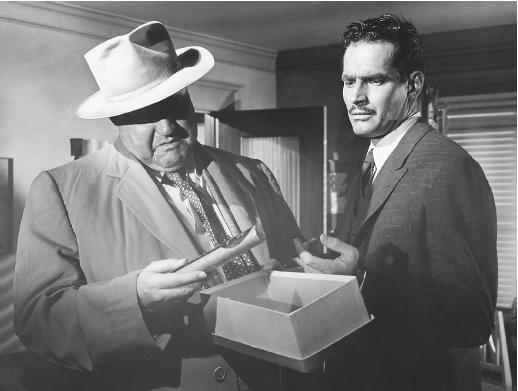
Few film directors have much allegiance to either of these dicta. They prefer to concentrate on things like story, character, psychology, emotion, whatever. Nevertheless, movie history is studded with the names of directors reputed to be great movers of the camera. The opening shot of Orson Welles's Touch of Evil is justly celebrated; less well known is another one-shot scene later in the movie--the one where Welles's Quinlan plants evidence on an incidental character. Less flashy if no less virtuosic, the second shot is just as well motivated narratively as the first: its continuity allows you to see that sticks of dynamite have magically appeared in a box that was previously empty.

But neither of these shots is the tour de force that was the ballroom scene at the heart of Welles's earlier film The Magnificent Ambersons--before it was butchered by the studio. Welles made Ambersons when he was still riding high on the success of his radio show and commanded the biggest budgets in Hollywood history; the single shot that was to constitute the ballroom scene originally lasted 10 minutes. Much of the scenery was devised to be lifted away as soon as it disappeared from the camera frame, to make room for the track that was being laid down as the camera moved, and for the camera itself. For the most part, the camera followed the movie's two main characters, but there were occasional divagations. One involved a conversation among a random assortment of upper-crust party guests about a recent, fascinating, but also kind of frightening import from Europe, which no one could quite summon the courage to sample: the olive. It's exactly the kind of period detail that novelists relish, and it even had thematic significance, indicating both the opulence of the world in which the Ambersons moved--they were the first to be able to afford an imported delicacy--and its quaint antiquity. The studio complained that the conversation did "nothing to advance the story" and cut it, along with a couple other segments of the shot. It is one of my fondest hopes that I will live to see digital technologies progress to the point that the scene can be reconstructed, from the surviving stills and script and from samples of the movie's other scenes.

The early Renoir was a great mover of the camera, and even devised his own technology for tracking shots, a set of reconfigurable, interlocking, polished wood platforms over which a camera mounted on felt feet could slide, but he claimed he had to stop using it because it violated union guidelines. Tarkovsky, Mizoguchi, Minnelli, Demy, Ophuls -- all were masters of the tracking shot. But to me, the most virtuosic mover of the camera is Luis Bunuel.

Lots of cinephiles are shocked when I say this. Bunuel is thought to have a rather dry style, and indeed, he seems to deal mostly in medium shots, which have neither the drama of the closeup nor the pathos of the long shot. But his camera is always moving. I pointed this out once to a guy who was teaching a class on film appreciation at the Cambridge Center for Adult Education, and he said, "That's not moving, that's framing." By which he meant, Bunuel's camera movements are generally motivated by his characters' movements. Fair enough. But who decides the characters need to move? In a lot of movies, they don't. They stand or sit, and the camera cuts back and forth between them, in what, in my film days, I would disparagingly refer to as "composition tennis". Bunuel finds reasons to make his characters move precisely to have a reason to make the camera move.

A good example is the opening of Discreet Charm of the Bourgeoisie, about three minutes into the Criterion disc. The scene in the Senechals' house takes exactly two shots, and the characters are constantly moving about, dragging the camera with them. Indeed, sometimes, when you start paying too much attention to Bunuel's direction, his shots begin to seem incredibly contrived, with characters moving into the background and positioning themselves so that they exactly fill in the visual gaps between characters in the foreground. But of course, if you're watching as you normally would in the cineplex, you hardly notice what the camera is doing. You just find that you have a very clear sense of the three-dimensional space of the scene, and a general impression of elegance.

All of this is apposite because Criterion -- God bless Criterion -- has just released a DVD of Bunuel's Milky Way, my favorite of his films. In it, he makes my corollary to the NYU aesthetic principle -- don't reuse a shot once you've left it -- a structural conceit, disdaining to reuse settings and even, with the notable exceptions of the two protagonists, characters once he's left them. He actually takes this structural principle even further in The Phantom of Liberty. Perhaps he takes it too far -- or perhaps, without the ready-made imagery of the history of the Catholic Church, he's just unable to repeat the combination of comedy and pathos that he manages so brilliantly in Milky Way. Either way, I've always found Phantom the lone disappointment among his late, European films. But The Milky Way is a masterpiece.

Wednesday, August 8, 2007

Music primer, part (hopefully) the last

Okay, it occurred to me that I would probably have regular recourse to a couple more music-theoretical ideas, so I should just go ahead and get them out of the way now.

Relative and parallel minor

I mentioned in my last post that the natural-minor scale is a permutation of the major scale -- the major scale begun on the sixth scale degree and wrapped around on itself. That means that for any given major key -- C, E, B-flat -- there is a minor key that uses all the same notes. On the piano, the C-major scale uses all white keys; so does the natural A-minor scale. The E-major scale uses black keys at F-sharp, G-sharp, C-sharp, and D-sharp; so does the natural C#-minor scale. Etc.

If you read the section on whole and half-steps carefully, you will have noticed that the minor scale that shares all its notes with a given major scale begins a minor third down from the first note of the major scale. A is a minor third down from C; C# is a minor third down from E. The minor scale that shares all its notes with a given major scale is called the relative minor of the major scale; the major scale, naturally, is the relative major of the minor.

But of course, you can build a minor scale on any note, just as you can build a major scale on any note. You just have to make sure to follow the pattern of whole and half-steps we established last time:

WHWWHWW

So you can build a minor scale that starts on C or E, too. But those scales will use different notes than the major scales starting on the same notes and, perforce, different notes than the major scales' relative minors, too. On the piano, the minor scale built on C uses black keys at E-flat, A-flat, and B-flat; the minor scale built on E uses only one black key -- at F#. What are the relative majors of C-minor and E-minor? Count up a minor third from the first note of each scale (C and E); answer below.

The minor scale that begins on the same note as a given major scale is called the parallel minor. The major scale that begins on the same note as a minor scale is, of course, the parallel major.

Chords

I want to say at least a little about harmony (chords). As I mentioned in my first post on music theory, a chord is a set of notes played simultaneously. Any set of notes can constitute a chord, but in classical music of the classical period (not the pleonasm it seems, pending some better term than “classical music”), and in the vast majority of pop music, the chords that predominate are what used to be called “common chords” -- the major and minor triads. Technically, any chord with three notes is a triad, but musicians generally use the word to denote three-note chords constructed from stacked thirds.

By “stacked thirds” I mean that the triad’s second note is a third above its first note, and its third note is a third above its second note. If you were paying attention to my discussion of intervals, however, you’ll recall that a third can be either major or minor, i.e., it spans either four or three half-steps. Two types of thirds give you four types of stacked-third triads, named as follows:

major third on major third: augmented triad
minor third on major third: major triad
major third on minor third: minor triad
minor third on minor third: diminished triad

Of these four types of triad, however, the major and the minor are by far the most common. If you’ve ever sat down to learn a couple chords on the guitar, you were probably learning to play major triads, with possibly a few minor triads thrown in. If you can play “Heart and Soul” on the piano, you can play a few major triads. Etc.

Qualitatively, major triads partake of the brightness of the major scale; minor triads partake of the melancholy or ominousness of the minor scale. If you know any pop songs that have a kind of spooky or gloomy feel to them, they probably feature a lot of minor triads.

There are seven notes in the major scale, so there are seven natural triads in any major key. (For instance, the natural triad built on the first scale degree would consist of the notes 1, 3, and 5; the triad built on the third scale degree would consist of the notes 3, 5, and 7.) Of the seven natural triads in a major key, three are major triads, three are minor triads, and one is a diminished triad.

The three natural major triads are the ones built on the 1st, 4th, and 5th scale degrees. The triad built on the first scale degree is known as the tonic, and it’s kind of the “home base” for the key: most pop songs that are written in a single key probably start on the tonic, and almost all of them end on the tonic. The chords built on the 4th and 5th scale degrees are called the subdominant and dominant, respectively. As their names imply, they are very closely related to the tonic. If you’ve ever heard the term “three-chord pop song”, the three chords in question are the tonic, dominant, and subdominant.

The natural triads built on the 2nd, 3rd, and 6th scale degrees are minor triads. That means that a major triad built on one of those scale degrees perforce takes you into a different key (or at least into a different mode).

Finally, I’ll just mention that the next most common chords after the major and minor triads also consist of stacked thirds; it’s just that the stacks keep getting higher. A seventh chord, for instance, consists of a triad with another third stacked on top of it. (The second note of the chord is a third above the first note; the third note is a fifth above the first note; and the fourth note is a seventh above the first note, hence the chord’s name.) A ninth chord consists of a seventh with another third stacked on top of it. Etc. Sevenths are very common: in any given key, the seventh chord built on the fifth scale degree -- the dominant seventh -- is almost as common as the natural major chords. Again, if you’ve ever fooled around with the basic chord shapes on a guitar, you probably learned a couple dominant sevenths.

Answer key: the relative major of C minor is E-flat major; the relative major of E minor is G major.

Monday, July 23, 2007

Music primer, part two

Half-steps and whole steps

As I mentioned in my last post, the major scale has seven notes in it: if you start on middle C and play up the keyboard, you'll play a total of seven notes before you reach the next C. As I also mentioned in my last post, you will also skip five black keys.

Each of those black keys lies between two white keys. But obviously, if you have five black keys distributed among seven white keys, there are a few white keys that don't have black keys between them. The relationship between adjacent white keys that aren't separated by a black key is different from the relationship between adjacent white keys that are. Adjacent white keys separated by a black key are a whole step apart. Adjacent white keys that aren't separated by a black key are a half-step apart.

The difference between the vibrational frequencies of notes a whole step apart is greater than the difference between the vibrational frequencies of notes a half-step apart. As you might imagine, there is a sense in which the distance between notes a whole step apart is twice that of notes a half-step apart. But it's a rather technical sense that I don't want to get into here. (If you're interested in reading more on the subject, you might start with this Wikipedia entry.)

The relationship between whole steps and half-steps is easier to see on the neck of a guitar than on the keys of a piano. The metal frets embedded in the guitar neck mark off consecutive half-steps. To play the melodic interval of a whole step on the guitar, you have to jump across two frets; one fret will take you only a half-step away.

Finally, the distance between a white key on a piano and the black key next to it is a half-step. So you can see that the octave (eight-note span) from C to C -- on a keyboard or on a guitar -- is actually divided into 12 half-steps. On the keyboard, most of those half-steps are between white keys and black keys, but two of them -- from E to F and from B to C -- are between white keys. (There are in fact good mathematical reasons that Western music divides the octave into 12 equal half-steps.)

The major scale revisited

Armed with the notion of half-steps and whole steps, we can make a little better sense of the notion of a major key.

Play up the major scale from middle C to the C above it (all white notes). There's a black key between C and D, so the first step of the scale is a whole step. Same with D to E. But there's no black key between E and F, so that's a half-step (can you hear the difference?). Whole step to G, whole step to A, whole step to B -- then a half-step back to C. So the pattern of whole and half-steps that gives you a major scale is

WWHWWWH.

That's why you need black keys if you start your major scale on any note other than C. Start on D. Your first whole step takes you to E. But E to F is only a half-step, so your second whole step takes you to F-sharp. Then comes a half-step: G. A, B, no problem -- but now you've found the other white-note half-step, B to C. So your next note has to be C-sharp, not C. And a last half-step will bring us back to do.

Make sense?

The same procedure, of course, applies to the neck of the guitar. You can start your scale on any fret you want. The next note will be two frets (a whole step) up. The one after that will be two more frets up. But the one after that (the first half-step) will be only one fret up. Etc.

The procedure works in exactly the same way no matter what fret you begin on. That's why pop guitarists tend to be less clear on the theoretical differences between keys than pianists: changing key on the guitar is just a matter of starting the same pattern on a different fret; each key on the piano has its own distinctive pattern.

Intervals revisited

The concept of whole and half-steps also lets me clarify some distinctions I elided in my last post. I mentioned that in any given major scale (I hope that the principle of the major scale is now clear enough to you that I can stop using C major as a reference point; C is, after all, just one of 12 major scales, none of which should, in principle, be privileged over any other), the distance from 1 to 6 is a sixth. The distance from 3 to the 1 above it is also a sixth. But they're not the same sixth. The sixth from 1 to 6 is a major sixth; that means there are nine half-steps from 1 to 6. But there are only eight half-steps from 3 to 1, making it a minor sixth. Here's the mapping of total half-steps spanned to intervals:

1: minor second
2: major second
3: minor third
4: major third
5: perfect fourth
6: augmented fourth/diminished fifth
7: perfect fifth
8: minor sixth
9: major sixth
10: minor seventh
11: major seventh

The interval of the diminished fifth (6 half-steps) is commonly called the tritone, or less commonly, the diabolus in musica. For a long time, it was considered a gross dissonance, to be avoided. In the 20th century, it was to some extent rehabilitated, but melodies that emphasize tritones can still sound sharp and spiky to the modern ear.

Other scales

So the major scale goes WWHWWWH. But you could, if you wanted, make your own scale out of some random sequence of whole and half-steps -- WHHWWHHW, or whatever. Twentieth-century jazz and classical composers experimented widely with the whole-tone scale (WWWWWW) and the octatonic scale (WHWHWHWH), but by far the most common scale other than the major is, unsurprisingly, the minor.

The minor scale

The basic minor-scale pattern is WHWWHWW. (It has variants, but I'm not going to get into them.) The distinctive thing about it is that the interval from 1 to 3 is not a major third; it's a minor third, the interval between "dead" and "and" in the schoolyard incantation "pray for the dead, and the dead will pray for you". Music written in minor keys tends to have a more melancholy, or brooding, or ominous, or menacing feel than music written in major keys: recall Nigel Tufnel's sage observation that D minor is "the saddest of all keys." Play any peppy tune you know on the keyboard with the third scale degree knocked down a half-step, and it will come out much less peppy*. The Christmas hymn "O Come, O Come, Emmanuel" spends a lot of time in a minor key -- as does Britney Spears's "Oops I Did It Again". Both songs occasionally slip into major keys, however, for reasons that I hope will come clear in the next section.

The modes

Take a look at the minor-scale pattern of whole and half-steps. The minor scale, like the major scale, starts over again at the octave. So two octaves of the minor scale will look like this:

WHWWHWWWHWWHWW

Trace out the eight-note pattern beginning on the third scale degree of the minor scale instead of the first. That is, knock off the first two and the last five letters:

WWHWWWH

Look familiar? Yes! It's the major scale! The minor scale is just the major scale begun on a different scale degree and wrapped around on itself. The converse is also true: the minor scale is the major scale begun on a different scale degree and wrapped around on itself.

Another way to say the same thing is, if you play an A on the piano, and play up the next seven white keys, you will have played the minor scale. (The white keys give you the major scale only if you start on C; they give you the minor scale only if you start on A.)

Note that starting the major scale on a different scale degree and wrapping it around will not give you the whole-tone or the octatonic scales: they have fundamentally different patterns (the whole-tone scale has no half-steps at all, so of course it can't give you the major scale). But if there are seven notes in the major scale, there must, perforce, be seven different "wraparound" scales (2 to 2, 3 to 3, 4 to 4, etc.). These wraparound scales are called modes. Two of them -- 1 to 1 and 6 to 6 -- are our familiar major and minor scales. Of the remaining five, three have minor thirds between 1 and 3, and two have major thirds between 1 and 3. The ones with minor thirds partake of the minor-scale melancholy; but the ones with major thirds have distinctive flavors all their own, and it's on those two that I will concentrate in this blog.

The two major-third modes (other than the major scale) are the lydian and the mixolydian. These are the scales that arise when you start on F and G, respectively, and play up the next seven white keys. They are also the modes that follow the following permutations of the major-scale sequence of whole and half-steps:

lydian: WWWHWWH
mixolydian: WWHWWHW

Each scale differs from the major scale in only one respect. The lydian mode has a raised fourth degree relative to the major scale. That is, in the lydian mode, 4 is a half-step higher than the 4 of the major scale. This makes the interval between 1 and 4 a tritone, which gives lydian melodies a piquant sound. The mixolydian mode has a lowered seventh degree relative to the major scale, a similarly fateful alteration. In the major scale, you'll recall, 7 is only a half-step below 1. That close proximity gives the 7 a feeling of kind of leaning toward the 1. It's hard to describe but very easy to hear -- it's the sense in which it instinctively brings us back to do. Widening that interval removes that leaning feeling, which drastically changes the color of the scale.

Because all the modes consist of the major scale wrapped around on itself, it requires a certain amount of effort on the part of the composer to keep modal melodies from simply drifting back into the major: our ears, conditioned by so much major-key music (and possibly predisposed by evolutionary adaptations), tend to pull as back to the familiar (or perhaps the instinctive).

Okay, I think that's gonna do it. I may want to say more about harmony at some later point, but then again, I may not. The distinction between different keys may be as much of a harmonic distinction as I'm going to need to make.

* I'm sure that the popular Boston band the Dresden Dolls has some tunes in minor keys. I don't really know their music, but years ago, when Amanda Palmer was still busking in Harvard Square as the 12-foot bride, I saw her play some of her songs, solo, and without makeup or carved eyebrows, at the original Zeitgeist Gallery on Broadway in Cambridge. After she'd played about four or five songs in a row in minor keys, I yelled, "Play something in a major key!" She thought for a minute and said, "Hm, I don't think I've written anything in a major key since I was 17," and I said, "Back when you could still believe in major keys."